

RoboCop: Rogue City
Developer: Teyon
Publisher: Nacon
Platforms: PC, PlayStation 5, Xbox Series X|S (Tested on PC, PS5 and Series X)
Release Date: November 2, 2023
The original RoboCop from 1987 is one of the greatest movies ever made. The potent combination of satire, ultraviolence, and just plain old 1980s action movie coolness made RoboCop a surprise blockbuster and a household name in the late 80s and early 90s. Not too bad for a movie whose director, the legendary Dutch maestro Paul Verhoeven, initially threw Edward Neumeier & Michael Miner‘s script in the bin after reading the first couple of pages. His wife would eventually convince him to read the whole thing.

RoboCop spawned two disappointing sequels in 1990 and 1993, with RoboCop 3 being completed in late 1991 and slated for a summer 1992 release but delayed because Orion Pictures was busy going bankrupt. Now, I’m aware RoboCop 2 has its fans, some of whom insist it’s just as good as the original or maybe even better. They are of course entitled to their opinion, but they’re also completely wrong and the general consensus seems to agree. RoboCop 2 has a few genuinely great scenes, but the rest is a total mess that feels like three scripts (none of them particularly good) fighting each other. Meanwhile, nobody seems to like RoboCop 3, although it does have some decent ideas that should’ve been in a better movie.
Neither Verhoeven nor the original screenwriters returned for either film, which were based on different RoboCop 2 scripts by Frank Miller. To Miller’s chagrin, his scripts went through heavy editing, and a nine-issue comic book series allegedly based on his original RoboCop 2 script and RoboCop 3 notes was published from 2003 to 2006. Frank Miller’s RoboCop, which was overseen but not written or drawn by Miller (which, considering the quality of his output around this time, might have been a blessing of sorts), received mixed reviews and is arguably worse than either of the movie sequels.

Naturally, a blockbuster movie franchise meant all kinds of spinoffs and merchandise. It didn’t matter that the original movie was so violent it had to be submitted to the MPAA eight times before it managed to avoid an X rating. Of course, RoboCop was far from the only R-rated film at the time to have a toyline and a Saturday morning cartoon (RoboCop actually had two separate ones over the years)… and video games, naturally.

RoboCop games have never been particularly noteworthy, at least for their quality. The most interesting thing about the RoboCop games from the 80s and 90s is the way they initially came to be. Back in 1986, Gary Bracey from UK-based Ocean Software flew to Hollywood to look for properties his company could potentially turn into games. Ocean had been developing licensed games including movie tie-ins for a few years by this point, and this time Bracey ended up picking up the RoboCop license for peanuts. Or $20,000, which could buy lots of peanuts. The movie was early in development, and nobody really thought this silly little production about a cyborg police officer would amount to anything anyway. Oops. Ocean reaped the rewards as the game was a megahit when it launched in late 1988.

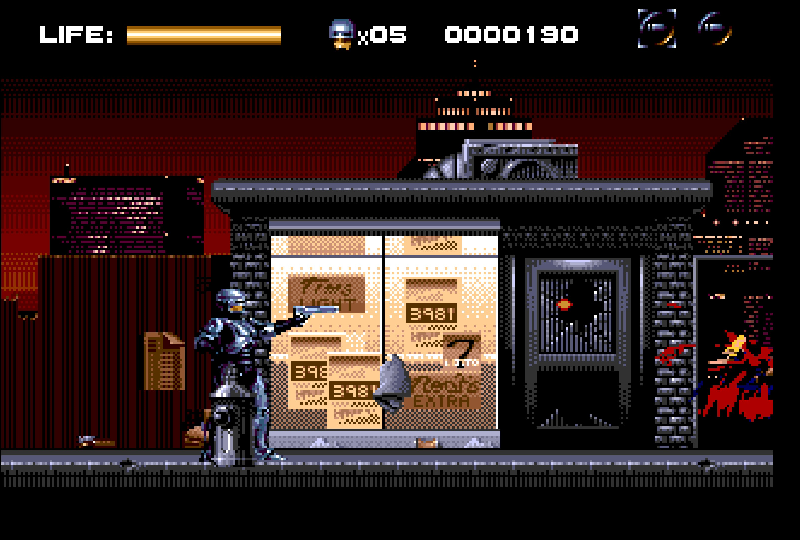
As Ocean was a UK company, they focused mainly on the home computer versions. These were, naturally, side-scrolling action games, which was the style at the time. Nothing too spectacular, but I’ll mention a couple of them here. The ZX Spectrum version by Mike Lamb (which later received an enhanced Game Boy port) was the most popular at least in the UK and has a fantastic soundtrack courtesy of Jonathan Dunn as well as a lot of surprisingly crisp speech samples, at least on the 128K and newer models. On the old 48K, you get the usual beeps and sometimes boops. Exciting stuff.
The Commodore 64 version (which is quite a different game, as versions on different formats were frequently handled by different people) has another great Jonathan Dunn soundtrack, but the game itself is not nearly as good and has become infamous for being released unfinished. That is not in the modern “has some silly bugs and might crash” way, but in the “literally can’t be completed” way.

The programmer couldn’t finish all the levels in time, so instead he made one of the earlier levels impossible to beat by normal means. You could get through with some trickery, but eventually RoboCop would just find himself in Glitch City and couldn’t progress any further. I know some gamers like to look back on the good old days because back then we didn’t have day one patches or any of that nonsense, how games were supposedly released in a complete and polished state, but in reality it was more a case of buggy games staying buggy or maybe being patched in a later revision if you were lucky. Occasionally, you’d have to send your game out in the mail to get a patched copy from the developer, which was particularly fun if you lived in a different country. Fans have since fixed RoboCop on the C64 and it can now be played normally from start to finish if you wish, although the C64 version wasn’t great to begin with.

It should be noted that Ocean wasn’t the only company to release RoboCop games around this time. Since Ocean had no experience with arcade game development, they sub-licensed the IP to Data East to produce the entertaining but obscenely difficult RoboCop arcade game, which also came out in late 1988 (release dates around this time period are murky at best, so I don’t know whether the Ocean or Data East game released first). Data East also published the 1989 NES game, developed by Sakata SAS, and developed the RoboCop 2 arcade game two years later.

Plenty of people have fairly logically assumed that Data East’s RoboCop arcade game was the original and Ocean then released ports of varying faithfulness for various systems as was the norm in those days, but this isn’t quite accurate. For the most part, the home and arcade versions of RoboCop have nothing to do with each other aside from being side-scrolling action games. The 16-bit Amiga/Atari ST/DOS version is the only home release clearly based on the arcade game, and it’s also not very good. To confuse matters further, there is a second DOS version that is based on the 8-bit micro versions!
The sequels got their own tie-ins from Ocean, most of which aren’t worth mentioning here. Digital Image Design’s RoboCop 3 for the Amiga, Atari ST and DOS deserves some attention, as it was a very ambitious 3D action game for its time (December 1991, months before the originally scheduled release of the film!) and platforms.
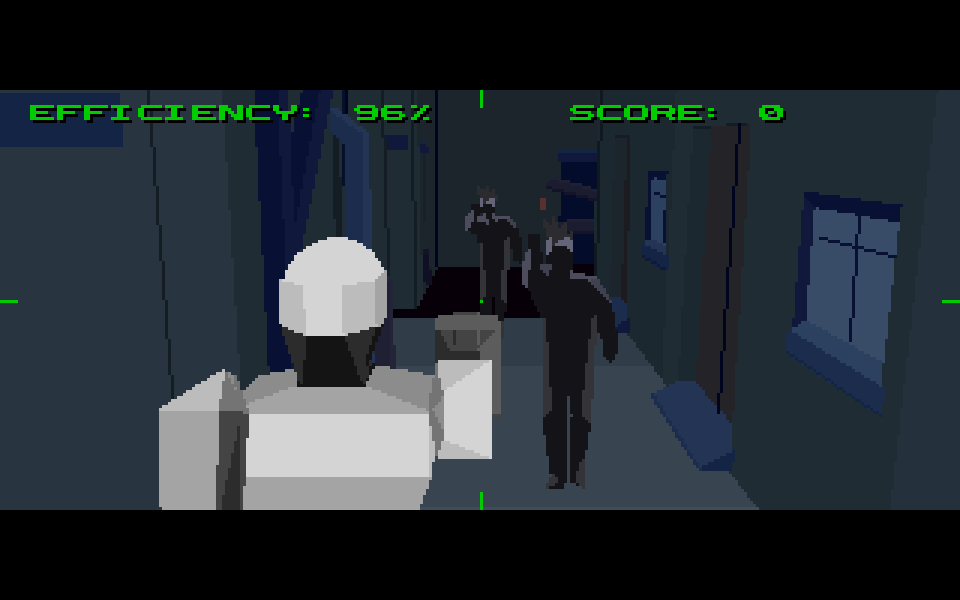
In an effort to combat piracy, the game came with a physical dongle that had to be plugged into the second joystick port. Naturally, this just annoyed paying customers and didn’t do much to stop anyone but the most casual pirates (which, to be fair, was the intent as Ocean wanted to maximize early sales), as the game was cracked a week before release (which was very much not the intent).
The RoboCop Versus The Terminator comic book by Frank Miller also got its own tie-in game for various formats in 1994, again from Ocean. The Mega Drive/Genesis version is probably the best known and most popular of these, as it is grittier and more violent than the other versions. It is also comically difficult.
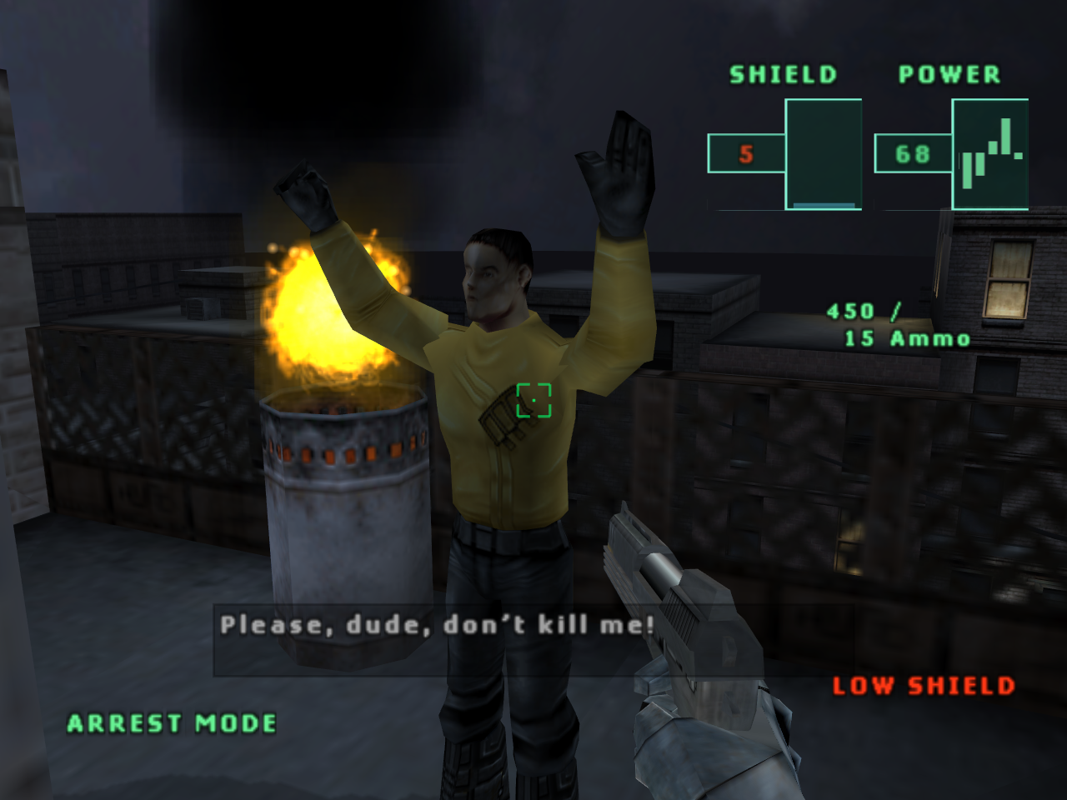
And then, there was Titus Interactive. Titus is best known today for their abysmal Superman on the Nintendo 64, but that’s far from the only awful game from the French developer and publisher (arguably not even their worst N64 game, thanks to Carmageddon 64 existing). Despite having spent most of the previous decade and a half making utter cack, they picked up the RoboCop license in 2001 and released an absolutely horrendous first-person shooter for the PS2, Xbox, GameCube and PC in 2003. I recently tried to watch Giant Bomb’s Blight Club playthrough of this game but gave up a couple of videos in because the game was too horrible and frustrating. Titus also released a Game Boy Color game based on RoboCop in 2001.
By the time the Caen brothers released their abomination, RoboCop as a franchise was practically dead. After the movie sequels in the early 90s, there was a syndicated 1994 TV show aimed at a younger audience (younger than RoboCop 3, which was PG-13 but still contained bloody violence and death) as well as a 2001 miniseries that returned to the darker and more violent tone. Neither show found much of an audience, although the 1994 series isn’t too bad for what it is. The 90s cartoon… existed. The 2014 remake of the first film largely missed the point of the original. While the 1987 film was and is deservedly celebrated as a timeless masterpiece, nobody expected to see another RoboCop video game ever again. Surely, RoboCop appearing as a guest character in Mortal Kombat 11 – voiced by original actor Peter Weller, even! – would be as good as it gets.

Enter Teyon, a small Polish developer who got their start developing various budget games for platforms such as PC, Nintendo DS, and Wii in the 00s and early 10s, including the Heavy Fire series of rail shooters. Teyon teamed up with publisher Reef Entertainment – also mainly known for bargain bin games – to release Rambo: The Video Game for the Xbox 360, PlayStation 3 and PC in 2014. The team’s passion for the source material was evident, but the rail shooter gameplay was tedious and frustrating, technical issues were abundant, and the game was heavily criticized across the board.
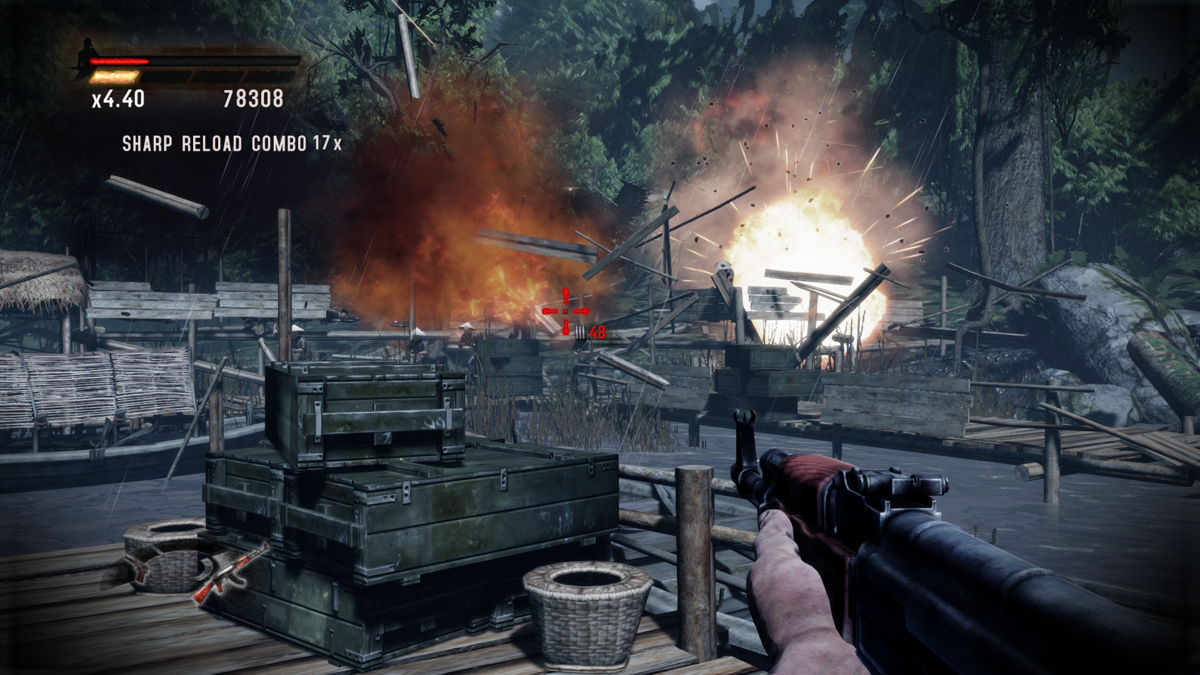
Teyon spent the next few years focusing on smaller projects once again. They also released a Rambo DLC episode, which was delayed to 2016 due to issues with the platform owners – the PC and PS3 DLC was released for free, but the 360 release was cancelled. In 2019, however, they would return to the 80s action movie license well with Terminator: Resistance for PS4, Xbox One and PC, again with Reef as the publisher. Considering how their last attempt went, most people weren’t exactly clamoring for another licensed game from Teyon and Reef.

Surprisingly, Terminator: Resistance turned out to be a very entertaining if unpolished action game and a real love letter to Terminator fans. In fact, several fans of the franchise have described Resistance as the real Terminator 3. That is high praise indeed, considering how just five years earlier the studio had been raked over the coals for their Rambo game. Professional reviews were mixed, but Terminator: Resistance was generally seen as a gigantic improvement over Rambo.
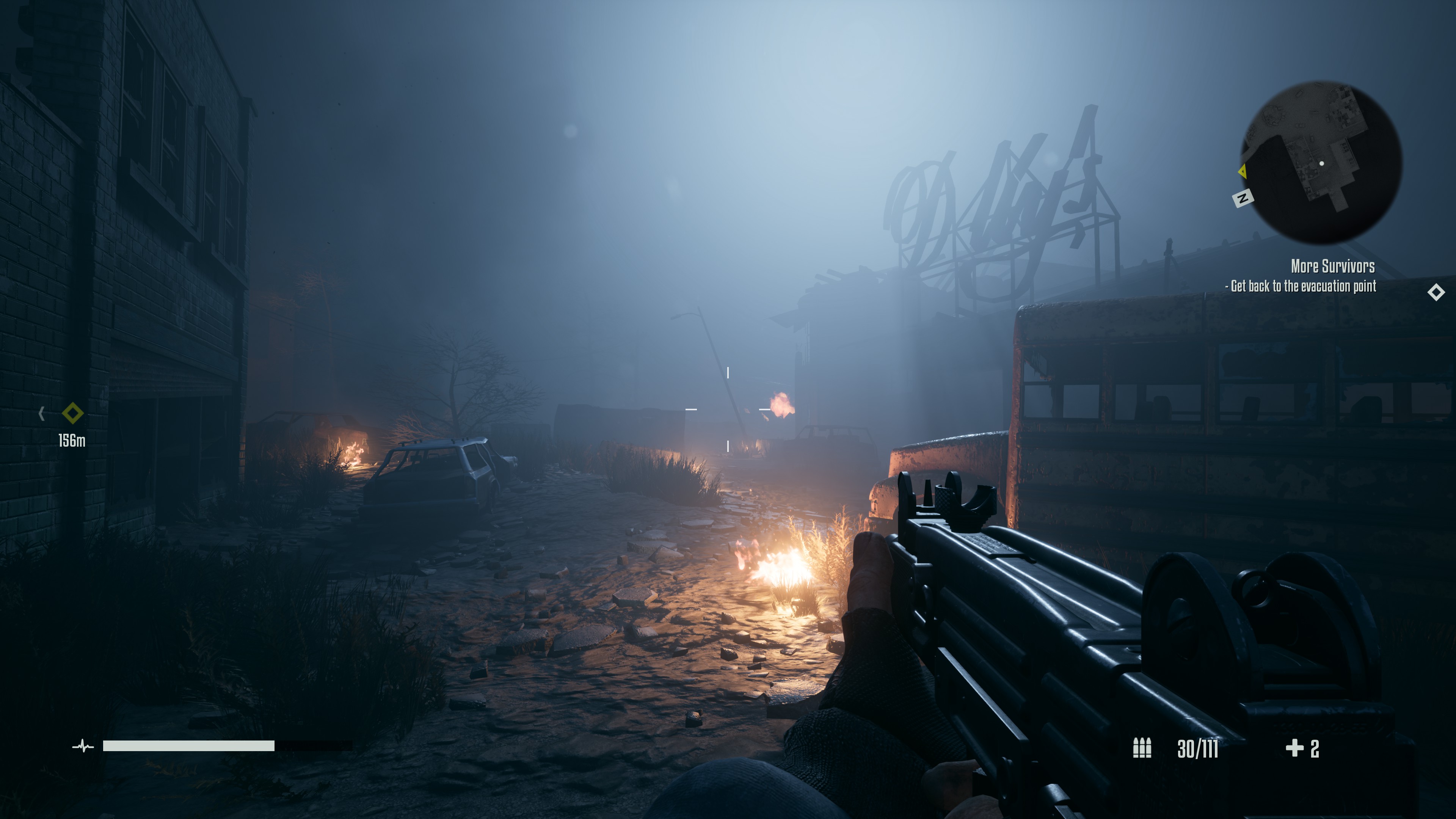
Teyon continued to support Resistance with updates and downloadable content, and in 2021 they announced their next big project – RoboCop: Rogue City. And that brings us, finally, to the game we’re actually looking at today. That took long enough! Well, if you’ve been reading this site for any length of time, you know how long-winded these can get.

Leading up to the November 2, 2023 launch of Rogue City, Teyon and publisher Nacon (probably best known for the horrendous Lord of the Rings: Gollum released earlier that year, but let’s not hold it against them this time) released a playable demo of the game on Steam. Despite some technical issues causing stutters and crashes, the surprisingly meaty demo – comprising the first couple of chapters from the campaign – was generally well received. Unfortunately, PlayStation 5 and Xbox Series players would have to wait until the game’s launch.

RoboCop: Rogue City is, as you’d probably expect from Teyon, a first-person shooter. They could easily have just made a linear corridor shooter, and it would still have been the best RoboCop game ever as long as the presentation was even half as good as Terminator: Resistance. Indeed, the game’s opening suggests exactly that as Officer Alex Murphy aka Omni Consumer Products Crime Prevention Unit 001 aka RoboCop (again voiced by Peter Weller) and his partner, Officer Anne Lewis (not voiced by Nancy Allen), shoot their way through a TV station that has been overrun by the Torch Heads gang in an attempt to get the attention of the mysterious “New Guy in Town”, who has been making moves in the underworld following the events of RoboCop 2. Meanwhile, RoboCop is experiencing strange glitches and visions of his past life, which potentially means bad press for OCP and we can’t have that, can we?
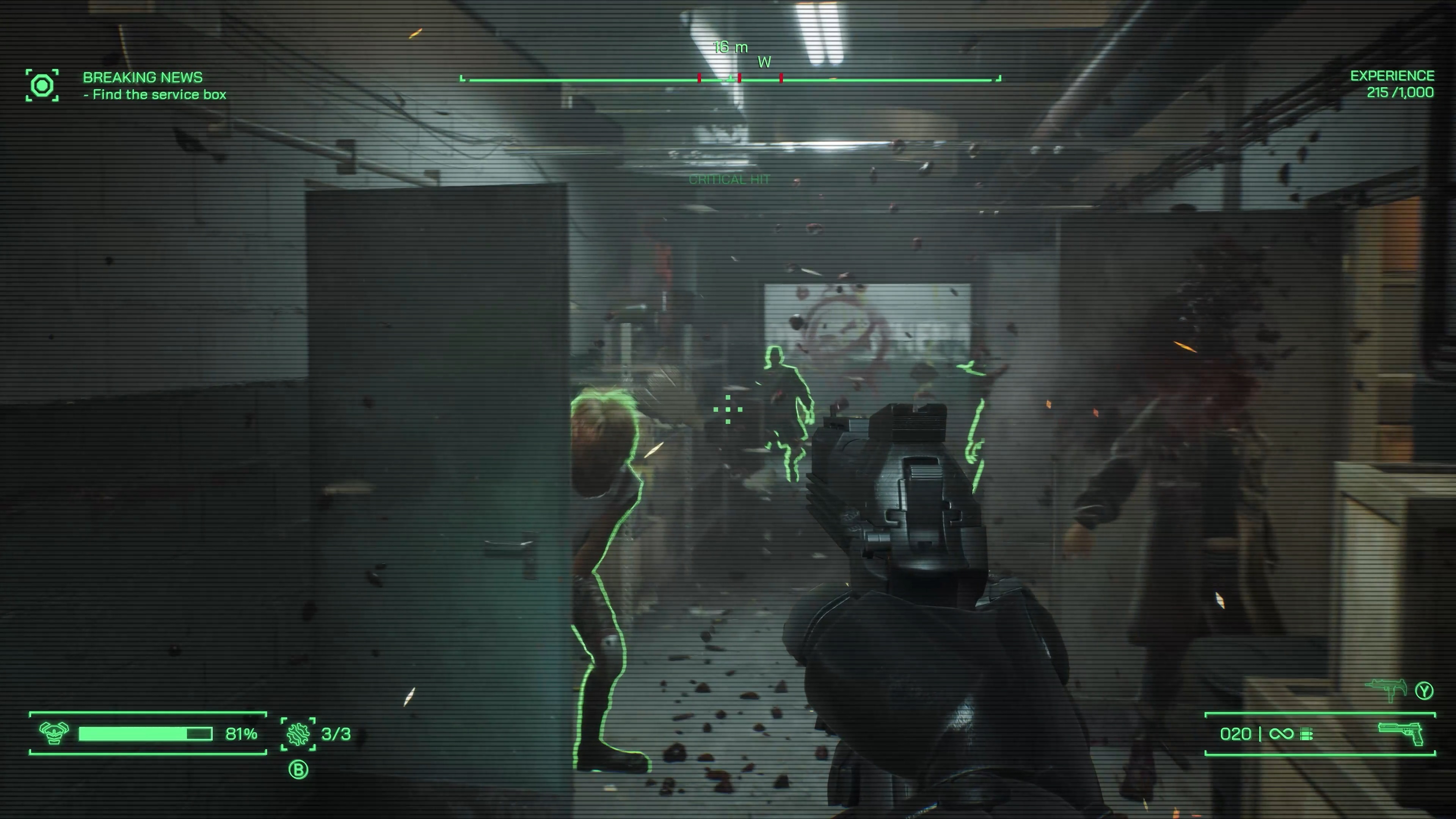
While Rogue City obviously isn’t a rail shooter, it sort of has the flow of a rail shooter here, with many enemies popping up from various nooks and crannies as you approach. As I mentioned earlier, Teyon has a history developing rail shooters, and some of that influence is definitely felt here. It actually reminds me of the more linear levels in the classic GoldenEye 007 such as Silo, which were designed with rail shooter gameplay in mind before the team at Rare took Bond off the rails.
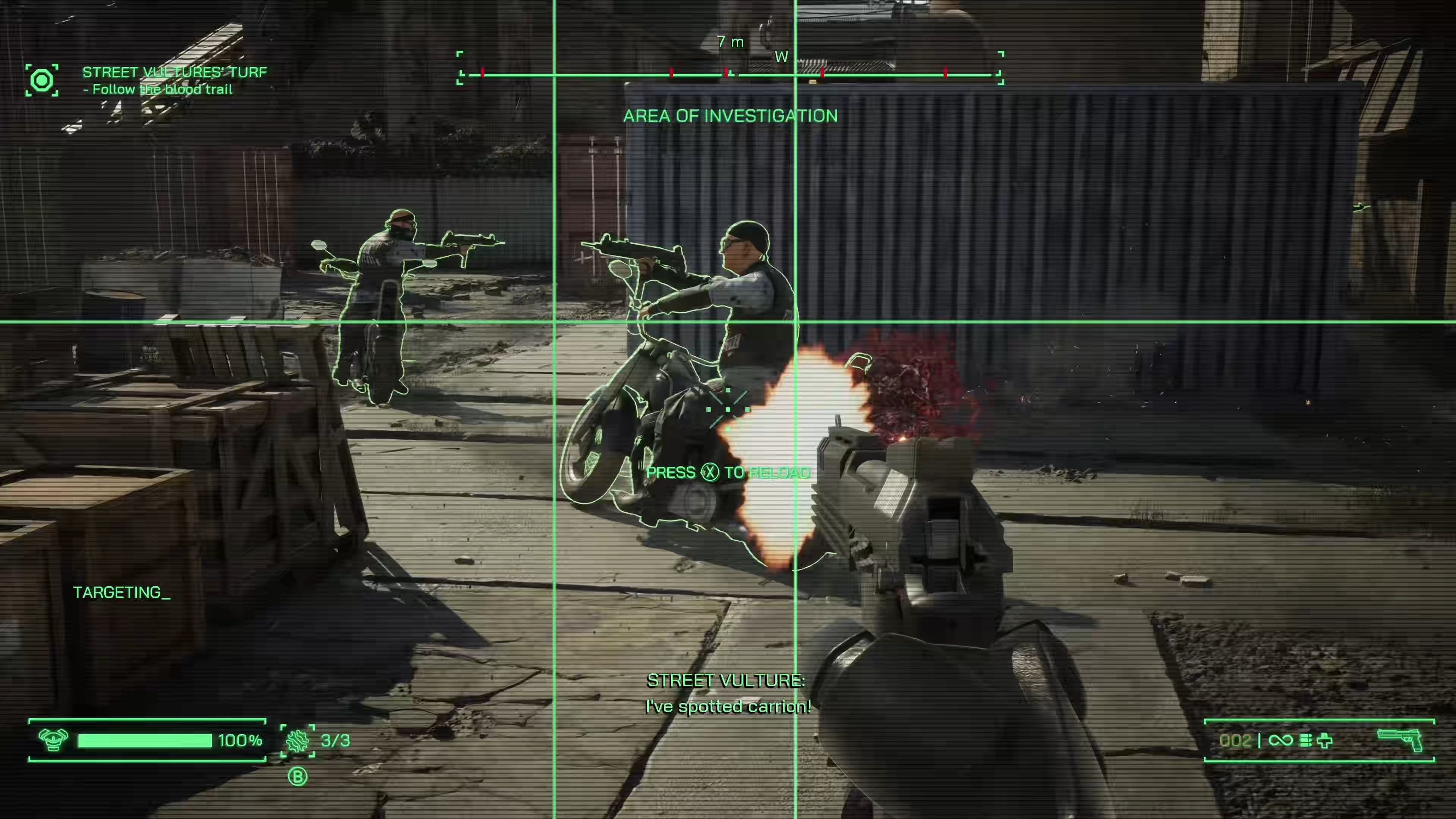
When designing the combat, Teyon set out to basically replicate the feel of the classic Rock Shop scene from the original RoboCop film, and they nailed it. Blasting creeps into red mist with RoboCop’s almighty Auto-9 hand cannon feels just right, especially with Basil Poledouris‘ magnificent theme song and other action themes from the movie swelling up as the Auto-9’s three-round burst provides an additional layer of percussion. RoboCop’s movement is suitably heavy but not too slow, his targeting system highlights nearby enemies just like in the film, the environmental destruction is on point, the comically over the top ultraviolence is faithful to the film… it’s just great stuff all around. There’s an achievement for shooting an enemy in the groin.
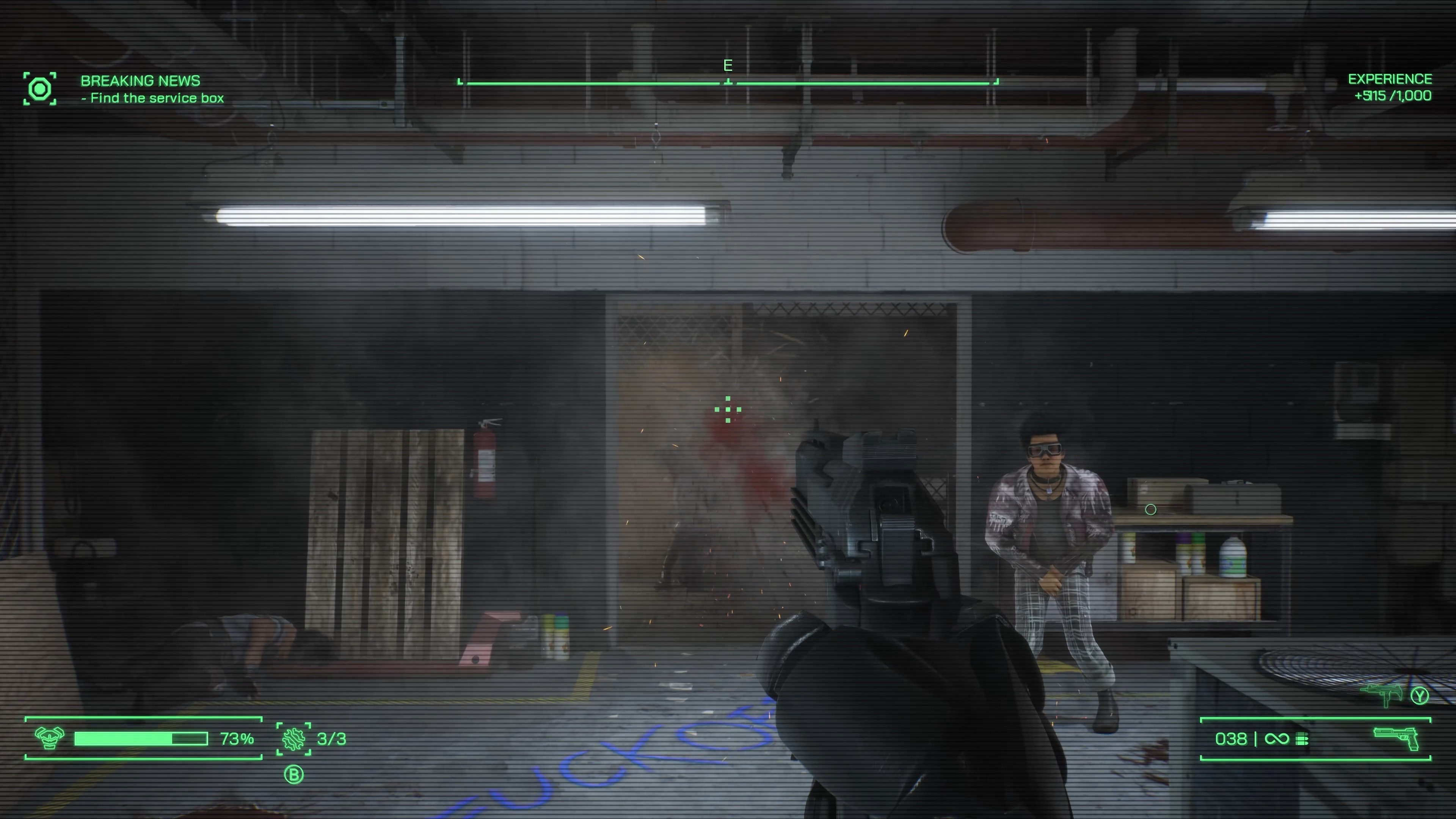
RoboCop being a walking tank has traditionally posed some problems in terms of game balancing. If you’ve seen the films (if you haven’t, stop reading this right now and go watch the original RoboCop), you know it takes an obscene amount of firepower and/or a lucky shot to even slow him down. To keep some semblance of difficulty here, RoboCop isn’t quite as bulletproof as he is in the movies, at least not in the beginning. He can still take down an army of goons without breaking a sweat (well, metaphorically speaking, as I don’t think Murphy can physically sweat at this point), but you do have to heal him with OCP recovery charges and fuse boxes to keep him going through all the gunfire he inevitably takes from the heavily armed enemies. It would hardly be suitable for RoboCop to hide behind cover all the time.
The Auto-9 is of course your primary weapon. To start with, it’s a fine gun with a three-round burst and infinite ammo – although you still need to reload after 50 shots, which RoboCop never does in the movies, and it’s not quite as powerful as it perhaps should be. There is a decent selection of other guns you can pick up as well, usually from enemies who can carry anything from 9mm peashooters and SMGs to sniper rifles, heavy machine guns and rocket launchers and even the almighty Cobra Assault Cannon in a couple of cases. If you aim properly, it destroys an ED-209 in two hits just like it should.
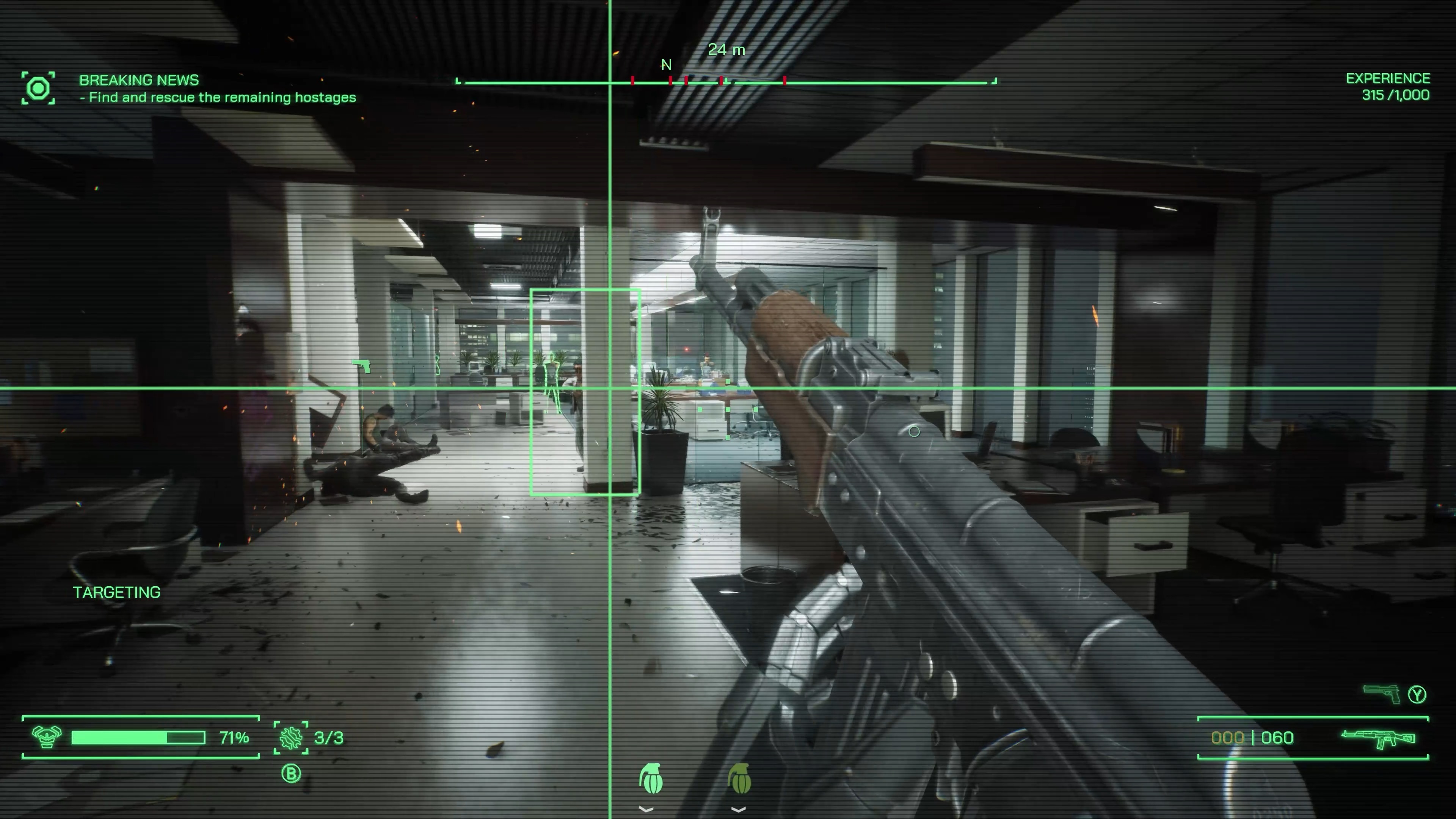
While the side weapons are often powerful and a lot of fun to use especially early on (the SMG in particular is very satisfying in the early game), they also have limited ammo that must be replenished by picking it up on the field. Their utility tends to drop off as the Auto-9 gets stronger, but a few of them remain useful throughout the campaign. When you’re playing a RoboCop game, you probably want to use the Auto-9 as your main gun, but only using the Auto-9 the whole game would get old after a while. Here, the side weapons add some nice variety while not replacing RoboCop’s signature weapon.
You can also throw objects like chairs, CRT monitors or explosive canisters at enemies… or just throw the enemies themselves, or punch them with your mighty robo-fist. Unfortunately, RoboCop’s data spike goes unused in combat. Sure, him using the spike on Boddicker in the film was a desperation move and not at all what it was designed for, which means he probably shouldn’t use it as a weapon all the time. You do at least get to stick it in various receptacles for its intended purpose.

Just as you’ve gotten into the groove in the opening mission, the game opens up and reveals itself as an RPG-lite. Very much on the “lite” side, but still. Once the hostage situation at the TV station has been sorted out, RoboCop is free to explore the meticulously recreated Metro West police precinct, talk to people, and complete some simple sidequests. Not only that, but your performance at the TV station is ranked and you receive up to four skill points that are used to upgrade RoboCop’s eight skill trees.

Obviously, you can boost RoboCop’s combat prowess by giving him more health (and eventually health regen up to 75%) or armor or damage output, but there are also many other abilities you may want to consider instead. How about ricocheting bullets off certain surfaces or slowing down time? Or maybe you’d like to improve RoboCop’s scanner to find hidden rooms and items, or even highlight favorable dialog choices so you can better serve the public trust? All that and more is possible. There are skill checks in dialog! Skill checks! In RoboCop! What a time to be alive.

If you want even more customization, RoboCop’s Auto-9 has its own upgrade system that unlocks a few hours into the game and will eventually make most side weapons completely redundant if you know what you’re doing. This works a little bit like a combination of the usual Pipe Dream hacking minigame and the science puzzles in Insomniac’s Spider-Man. You have a circuit board with several nodes connected to each other, and your job is to route power through the PCB by installing upgrade chips (found in OCP containers throughout the game) to the nodes. Each node has an icon representing bonus damage, armor piercing, magazine capacity, etc. For example, if you put a +20% chip in a bonus damage node, you do 20% bonus damage. Simple enough. The upgrades stack as well, although each stat has an upper limit to make you ever so slightly less overpowered.

You can also merge chips to create new ones, which would be more useful if it wasn’t so reliant on RNG. The chip you get always seems to be more powerful than the three you put in, but the actual bonus percentage varies and the shape might not fit your setup either. Since there’s a limited number of chips per playthrough, you can technically waste them here until you no longer have enough to actually put on your PCB, but that’s not very likely to happen.
Each PCB also contains a variety of special ability nodes. Powering up one of these gives you upgrades such as an automatic ammo feeder (no reloading, ever), explosive or armor-piercing bullets, full auto fire, and even increased gore that has no gameplay effect but makes the already impressive squib-like effects even bigger and squishier. Just like when Paul Verhoeven decided to add some spaghetti sauce into the scene in the film where the OCP executive gets obliterated by the ED-209!

The PCBs also feature penalty nodes marked with a percentage. Connecting to one of these will decrease all your Auto-9 stats by that much, so you want to avoid them as much as possible. Sometimes, in order to pick up a certain ability, you have to also take a hefty stat penalty as you can’t avoid powering up both nodes, so you have to consider whether the ability is worth the tradeoff. This is a great idea but very underused, as there are very few unavoidable penalty nodes on the different PCBs. Some of the late-game (and New Game Plus) PCBs are also massively overpowered, but then again RoboCop himself is supposed to be massively overpowered and you can always crank up the difficulty if you want more challenge.
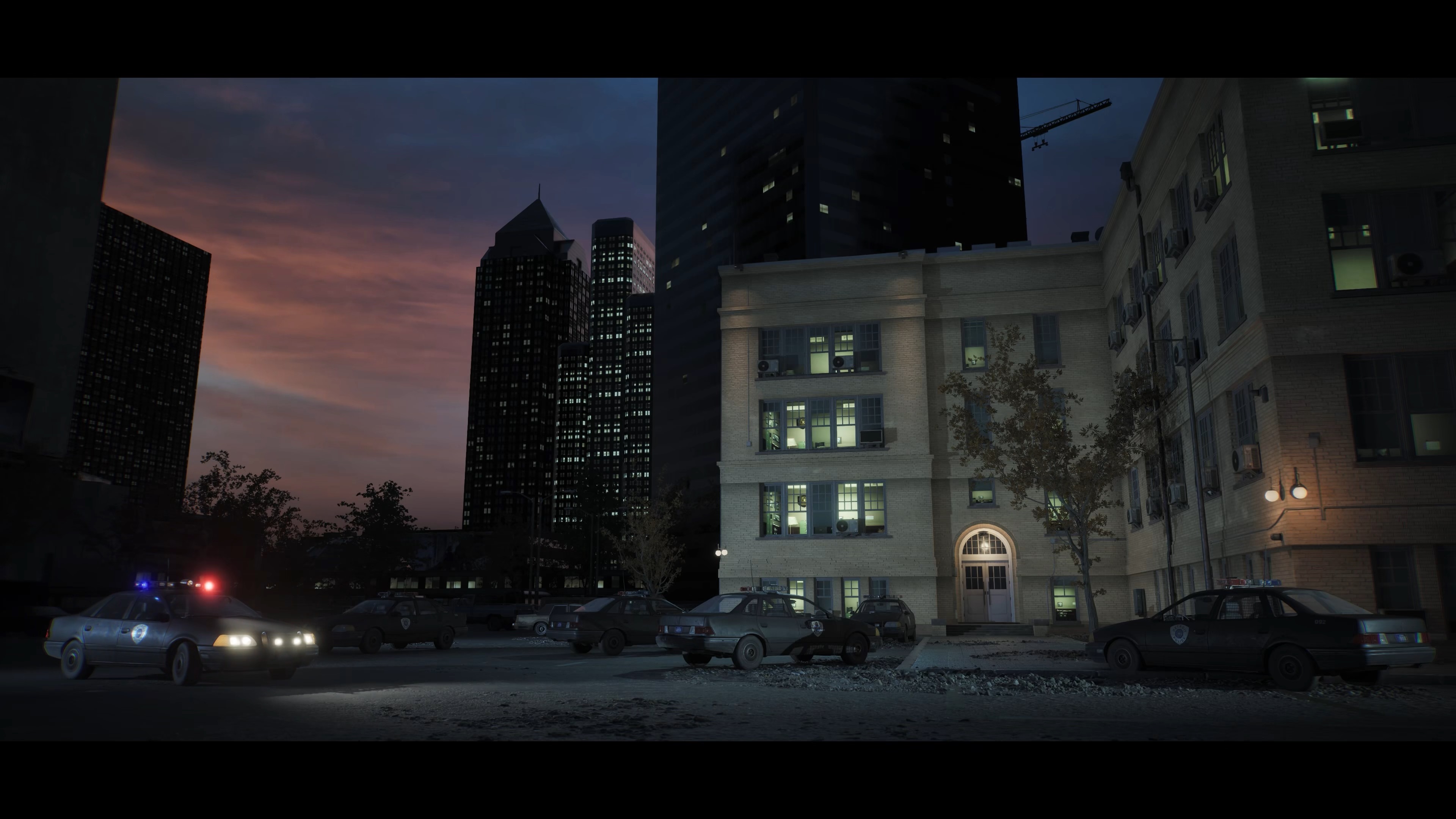
Following the briefing at the precinct, RoboCop is sent out on patrol in beautiful and scenic Old Detroit. This map is too small to really count as an open world, but it is an open area you can explore at your leisure. While your main objective is to investigate a lead on the boss of the Torch Heads and the New Guy, you can spend a good couple of hours here finding collectibles, handing out tickets (or warnings) for violations, and helping your fellow officers catch criminals in a variety of sidequests, some of which don’t even require firing a single shot as you’re tasked with investigating crime scenes and interrogating witnesses and suspects.
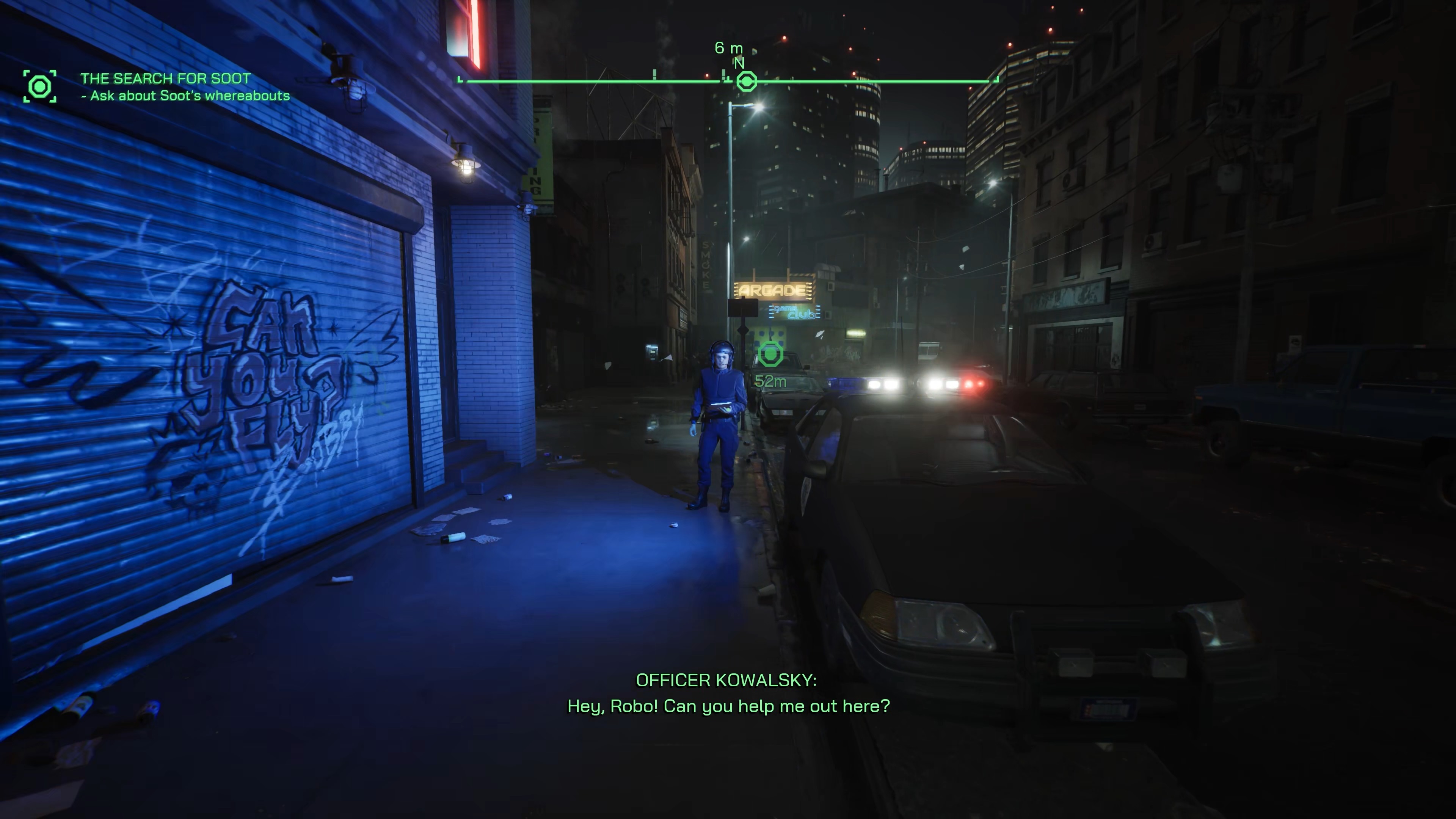
Generally, the game’s chapters are structured as follows: start at the police station, get evaluated on your last mission and attend a counseling session with psychologist Dr. Olivia Blanche, and complete some sidequests; get in your Ford Taurus and go to Old Detroit or a different area depending on the chapter; complete objectives in that area and shoot some bad guys; end with a big action setpiece that may or may not feature a boss fight. There is some variation, but usually things play out more or less in this manner throughout the 15 to 20-hour campaign.

As much as I enjoy the action setpieces in Rogue City, I also love the more mundane parts of the game. They remind me of Sierra’s classic Police Quest games, although of course this is considerably less strict when it comes to proper police procedure. You don’t have to walk around your Ford Taurus squad car to check its condition every time or anything like that, but it’s fun to take things slow and observe how RoboCop handles the parts of his job that weren’t shown in the movies. At one point in the early game, you get to man the complaints desk!

Rogue City has been compared to Eidos Montreal’s Deus Ex games. Obviously, you don’t have nearly as many options here (absolutely no non-lethal options for taking down bad guys outside scripted events, for example – it would’ve been nice to be able to arrest enemies), but the Deus Ex-lite elements do really add to the experience even though some skill trees are a bit underutilized. Did I mention the game has actual skill checks?
There are also multiple endings depending on your actions, with different outcomes for various characters you meet. I haven’t seen the ending you get if you play RoboCop as a cold, emotionless OCP robot because that’s just not RoboCop, but if you want to uphold the shit out of the law without caring about serving the public trust or protecting the innocent, you can do exactly that. However, as far as I’m concerned, RoboCop is Alex Murphy, a good man with a strong sense of justice and responsibility despite being developed to act as a tool of the unquestionable villains, and that is how I think Rogue City should be played.

I’m genuinely happy Teyon remembered RoboCop’s human side and made it and his relationship with Lewis an important part of the story here, because that side has largely been neglected ever since RoboCop 2 basically reset his personality and reduced Lewis to barely a character before she got clumsily killed off in the third movie (which, of course, Nancy Allen demanded as she wouldn’t reprise her role otherwise, but getting rid of Murphy’s only connection to his past life was perhaps not the best decision). The renewed focus on these aspects alone would make this game the second-best piece of RoboCop media ever created.
Some have said RoboCop is still a bit too robotic here compared to the end of the original film, but his personality manages to come through quite nicely and he’s definitely not the same bland action hero robot he was turned into in the second film. RoboCop in Rogue City is very capable of showing emotion and vulnerability, and he also has a slightly goofy sense of humor befitting a middle-aged dad like Murphy. Or maybe that’s a remnant of that time OCP briefly reprogrammed him into Adam West Batman in the second film.
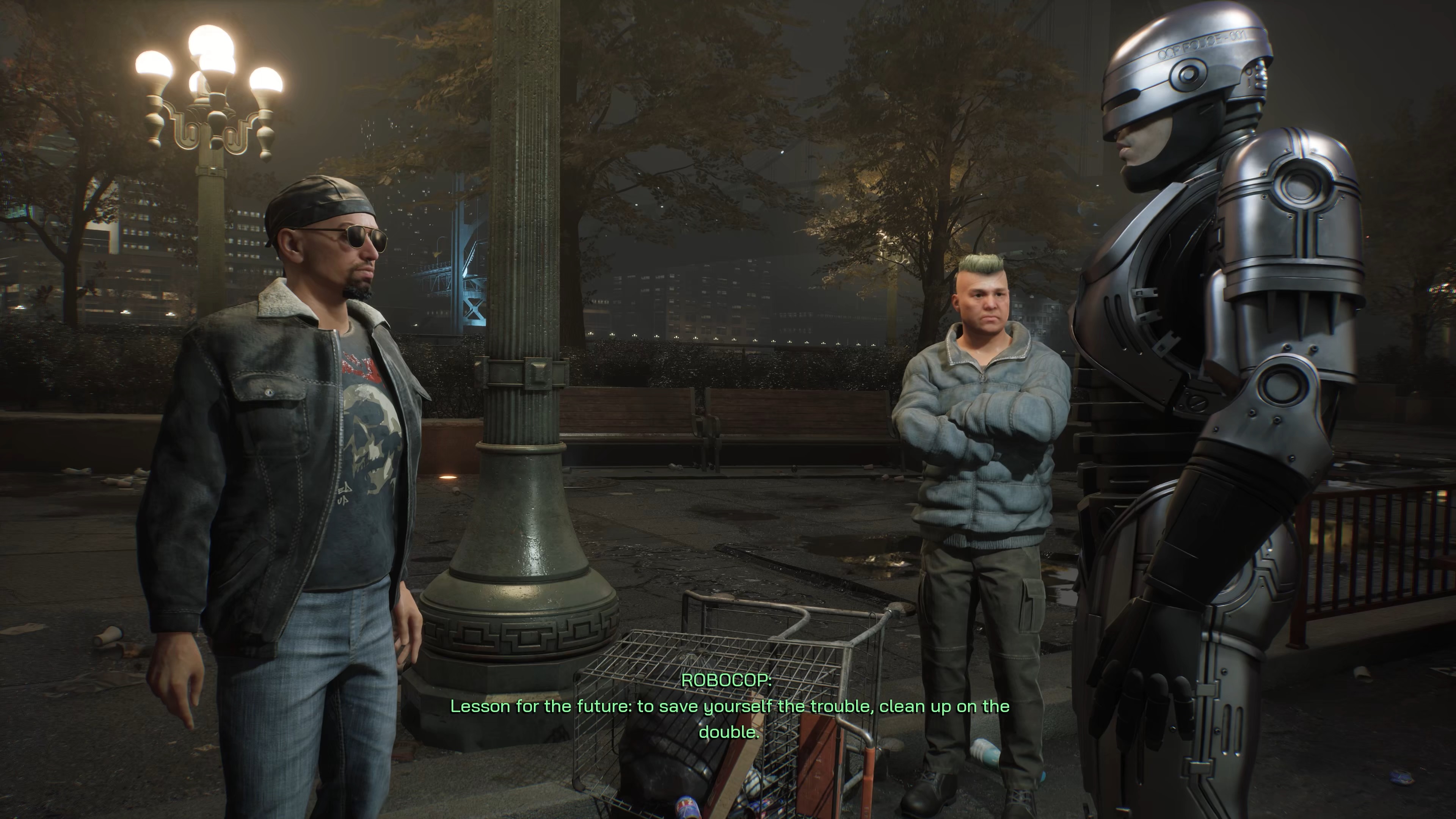
It should be noted Rogue City doesn’t retcon anything that happens in the films, except maybe the Old Man’s drastic personality change in the second movie. Here, the OCP CEO appears to genuinely respect RoboCop and acts more like his original self in general. RoboCop 3 can still happen in this continuity, and the story even sets it up in a few different ways. Still, from here on, I’m considering this the true, much better RoboCop 3, and I doubt I’m the only one.
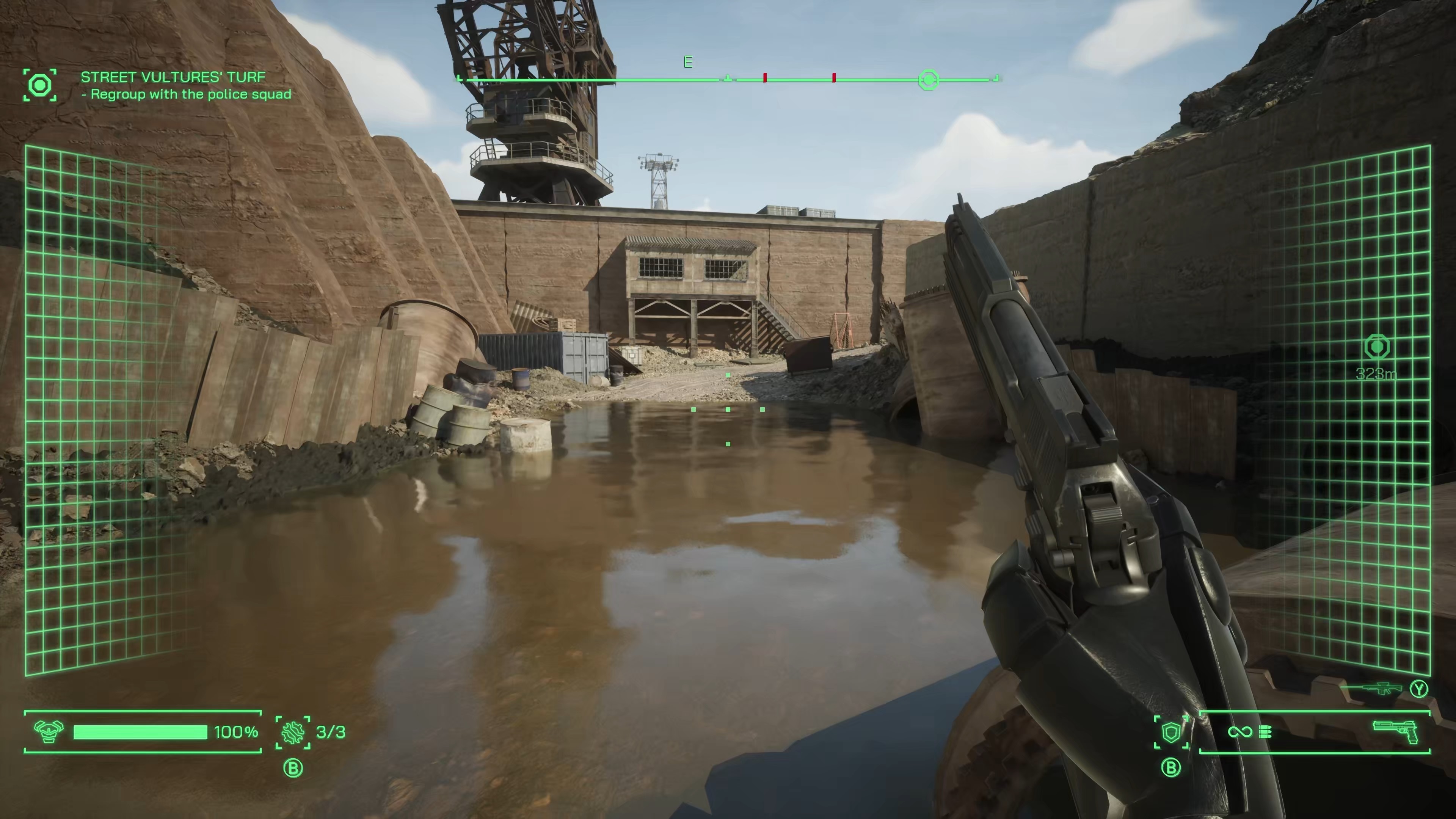
In terms of its technical makeup, Rogue City runs on Epic’s Unreal Engine 5 and makes very effective use of all its capabilities. We have software Lumen global illumination and reflections (not quite as nice as full hardware ray tracing but still very attractive indeed), virtual shadow maps, Nanite geometry with incredible granular detail and zero level-of-detail pop-in, the works. As you can probably tell from the screenshots, the game looks fantastic, especially on PC where you can enable high quality Lumen to improve the lighting and reflections further, as well as crank up the resolution and other settings. At times, the game looks like a prerendered CGI movie.

Admittedly, the characters aside from RoboCop himself don’t always look particularly great. The models themselves are generally quite detailed, especially when it comes to the more important characters like Lewis and Sgt. Reed, but their animation is frequently stilted and somehow more robotic than RoboCop. This is unfortunate but not enough to ruin the game by any means.

On the plus side, I absolutely adore how robots like the ED-209 and the spindly Urban Enforcement Droids (based on a failed RoboCop 2 prototype from the best scene of, well, RoboCop 2, but lacking the organic bits) are animated in a jerky, stop motion-esque style in cutscenes. I assume this is an intentional homage to the original effects work by Phil Tippett and his crew.
The environments, though – that’s where Rogue City absolutely nails it. Teyon has painstakingly recreated several of the movie sets to turn them into video game maps, and areas like the old steel mill, the OCP building and the Metro West precinct are just about perfect. The UE5 bells and whistles are used to ensure the atmosphere is exactly on point.

I’ve seen some people criticize the visuals and compare them to games from a decade ago, but aside from the stilted animation, that is simply factually incorrect because Rogue City‘s environments feature some of the most advanced real-time rendering we’ve seen this generation. It’s not quite the Matrix Awakens demo from a few years ago or this year’s Hellblade II: Senua’s Saga (I was on that game’s localization team for my language, not that you’d know it from the credits…) but is no slouch either, especially since Rogue City targets 60 frames per second on all formats. The fine fellows at Digital Foundry deservedly included Rogue City on their “Best Graphics of 2023” lists.
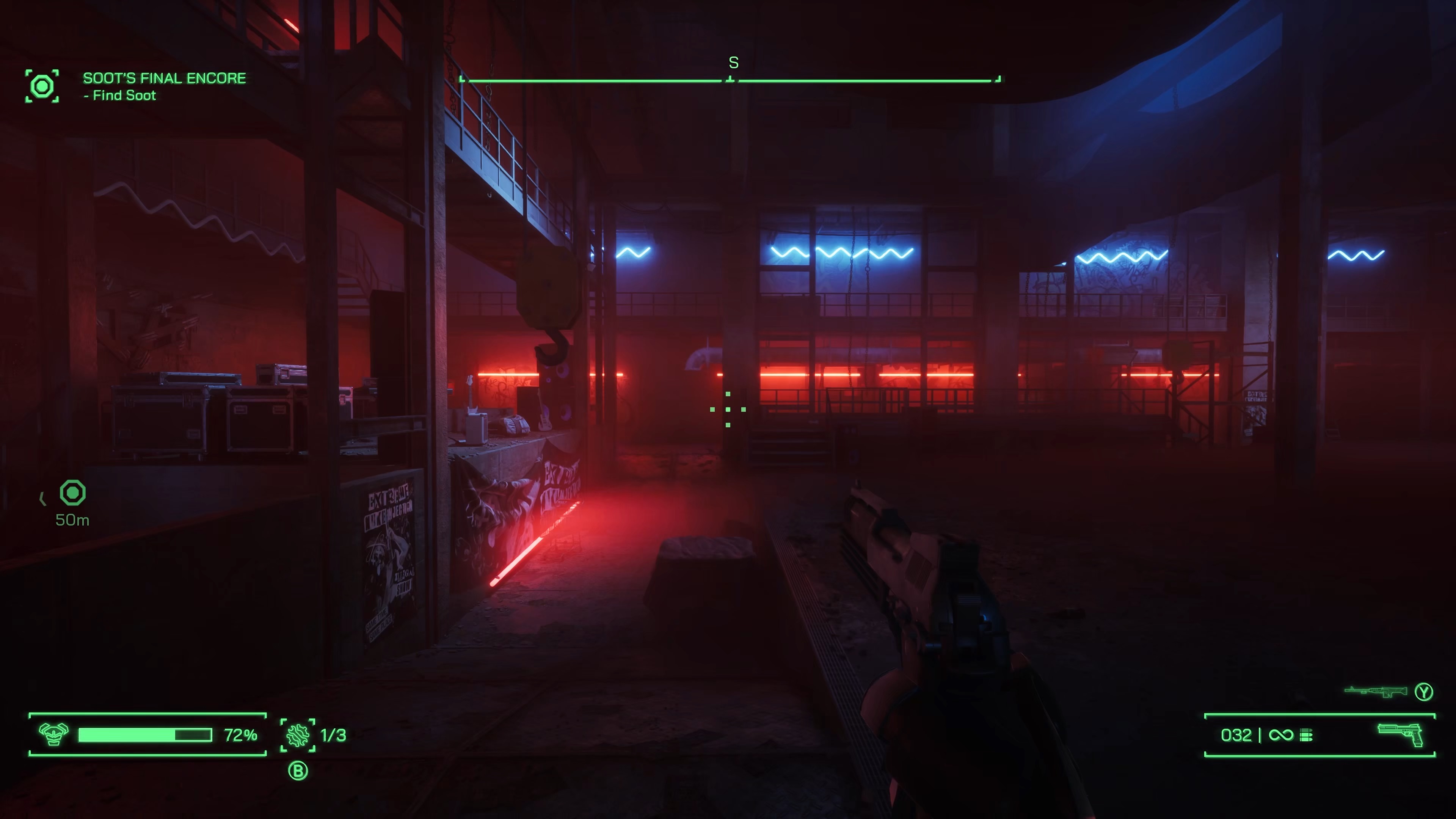
Speaking of Digital Foundry, let’s talk about the performance. Now, I bought an absolutely monstrous PC right around the time Rogue City came out, so I can’t really say much about how it runs on more modest hardware. I do know from DF’s content that the game is scalable enough to run at a reasonably playable frame rate on the Steam Deck for the most part, so I think a lot of PCs should do well enough with some tweaking.
That’s not to say Rogue City isn’t demanding if you’re looking to max out all settings. Even on an i9-13900K and an RTX 4090, Rogue City drops a few frames in certain cutscenes and particularly heavy gameplay scenes at native 4K maxed out, which admittedly does run at 60 fps or higher outside those stress points. The biggest firefight in the game manages to drop to the 50s even at DLSS Quality, which usually runs somewhere around 80-100 frames per second at max settings. The fancy UE5 features clearly don’t come cheap, although you can also get some free frames with DLSS Frame Generation if you have an RTX 40-series GPU – with all the usual drawbacks that feature introduces, of course, like screen tearing when the FPS exceeds your monitor’s native refresh rate.

The big issue on PC is the trademark Unreal Engine stutter we’ve seen in many games. Traversal stutter, shader compilation stutter, we’ve got it all here and it’s not great to say the least. It’s generally not distracting enough to ruin the experience, but you definitely notice the issue as you explore the maps and get into firefights with the bad guys. It gets considerably worse when recording gameplay at the same time, even if your settings (game or recording) aren’t massively high.
The console versions have less noticeable stutter, but they also frequently exhibit actual frame drops, especially in combat and heavier cutscenes. That big fight I mentioned that dropped to 50-55 fps at DLSS Quality (1440p internal resolution) on my monster PC completely and utterly tanks performance on both the PS5 and Series X versions. Yes, I own both of those and the PC version, and I have all the achievements from each of them. I have problems. But so does the game during that fight, as it lurches well below the 30 fps line in Performance Mode! At that point, even the excellent variable refresh rate implementation on the Series X won’t save you, and the PS5’s more limited VRR with its lack of system-level low frame rate compensation most definitely isn’t going to cut it.

The consoles also drop the internal resolution to 1080p or thereabouts while reducing the quality of the visuals somewhat. Aside from the lack of Lumen reflections on transparent materials like car windows and certain water surfaces, the cuts aren’t too noticeable and the game still looks great no matter what version you’re playing.
The Series S version (which I haven’t been able to test myself, as owning a Series X and a Series S would be a bit much even for me) removes Lumen reflections altogether and simply falls back on screen space reflections, causing the sort of issues you’d usually associate with SSR. The big console and PC versions also use SSR in combination with Lumen (or on its own if you so choose on PC) so you get some artifacts there as well if you angle the camera just right, but it’s less distracting than all reflections simply disappearing.
Audio-wise, things get rather interesting. It appears Teyon didn’t have access to the original recordings of the music and sound effects from the films, so everything has been re-recorded in-house. The music from the original film (thankfully not the forgettable RoboCop 2 soundtrack) has been faithfully recreated and sounds excellent, with some new tracks added as well. The slow piano rendition of the main theme in the menu is particularly lovely.
The sound effects are more of a mixed bag. Sharp-eared players will immediately notice that the Auto-9 doesn’t sound quite the same as in the films, which is true. However, the sound they went with is also considerably less harsh than the movie SFX, which is quite important because you will be listening to it for the better part of 20 hours. There is a mod to replace the Auto-9 sound if you really want that authentic experience, but I found the new sound more pleasant to listen to for extended periods of time. Most of the other new sounds can also be replaced with mods, with the exception of the ED-209’s animal growls and voice (at least last time I checked). This is unfortunate, because the ED-209 does sound a bit off.
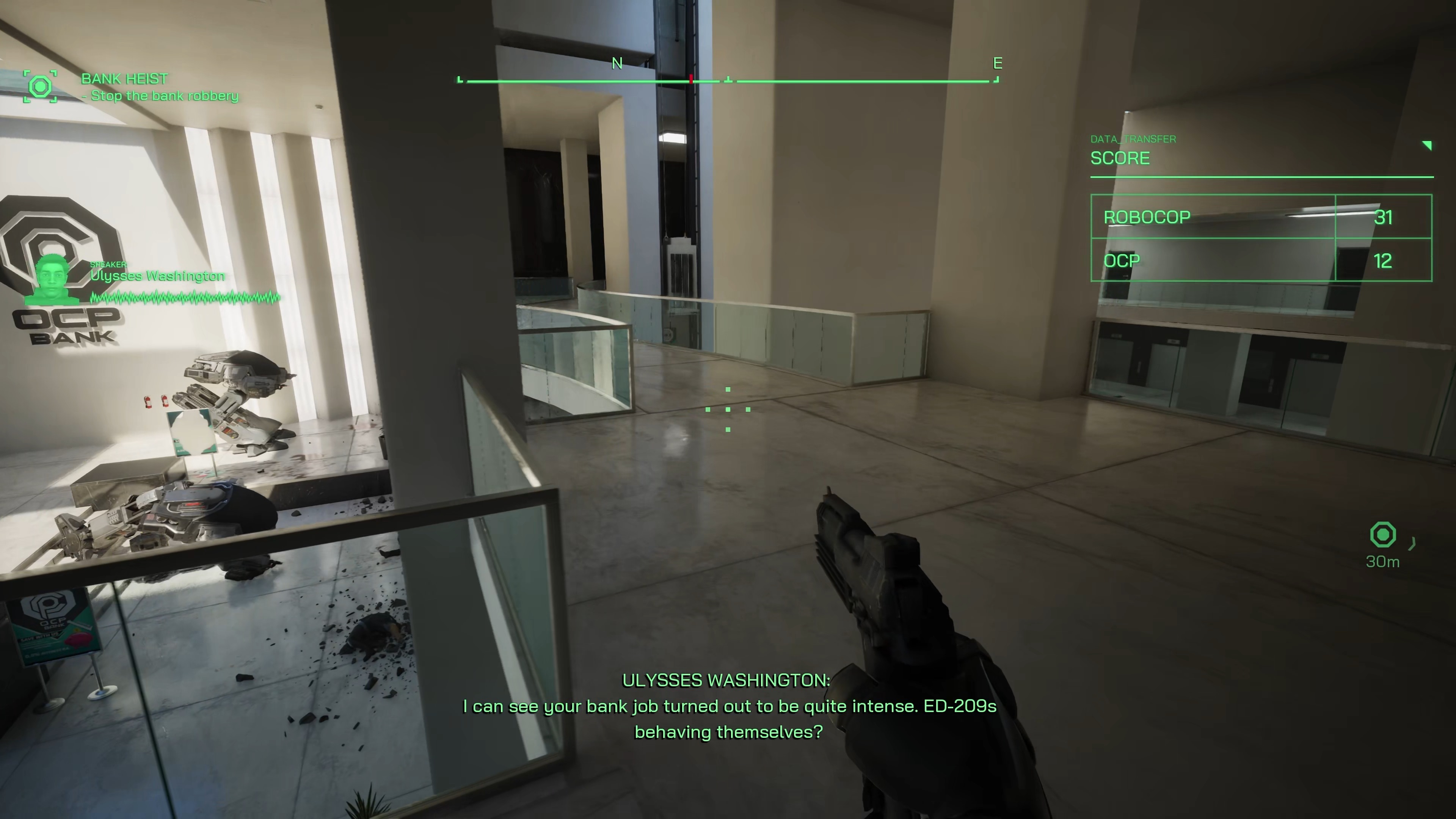
The voice acting is generally inoffensive. Peter Weller does a solid job as RoboCop aside from some dodgy direction on certain lines and brings a ton of authenticity to the presentation despite his voice having aged in the last four decades or so. The rest of the cast is nothing to write home about but generally not bad either. I do wish the Old Man sounded a bit better than he does here, though. Getting the original actor to reprise the role would admittedly have been somewhat challenging as Dan O’Herlihy died in 2005, but the actor they went with doesn’t sound quite right.
Rogue City is also not the most polished experience in general. The crash issues with the PC version seem to have been largely ironed out by the latest couple of patches as I didn’t experience a single crash during my recent replay on PC, but there are still graphical oddities here and there as well as some odd gameplay behavior and strange glitches.

While I couldn’t replicate this at all, on my PS5 playthrough I managed to somehow teleport from one area of the steel mill to a different area of the map by walking through a door. This should’ve taken me outside the underground tunnels I just exited, but instead it sent me back INSIDE the warehouse office I’d visited earlier. The same warehouse office where Murphy died in the movie, no less. Later on, the game actually does something similar as a mindscrew moment during one of RoboCop’s glitch/flashback episodes!

On the console versions, some of the skill checks also seem not to be working correctly. Instead of giving me the expected Psychology check dialog option and the NPC’s response to that, the game would just automatically skip to the NPC’s other line. Very odd, and it happened on both PS5 and Series X. Psychology is somewhat underutilized in general, and this sort of thing doesn’t help.

On PC, one of the updates earlier this year somehow broke the PCB upgrades in a way that gave me what amounted to an endgame Auto-9 early on in the game at the steel mill. At that point, you’re supposed to be able to have one PCB with the automatic ammo feeder and another PCB with full auto fire, but absolutely not both at the same time because that is obscenely powerful. I switched from the full auto PCB to the other one and somehow still had both full auto and the auto feeder! It was amazing. To give you some idea how powerful this is, it’s a bit like having an RC-P90 with infinite ammo in the aforementioned GoldenEye 007. The bug seems to have been fixed or just sorted itself out later in the playthrough, which took several months because I was LPing it.

So yes, a bit of the old jank of the Euro variety. This game was made by a relatively small team (I counted about 50-60 people under the Teyon section in the credits, and that includes office staff) who clearly prioritized fun and ambition, and I’m totally fine with that. There’s a reason this was one of my favorite games of 2023! The professional reviews were generally in the 7 or 8 out of 10 range, which seems about right. If you ask me, this is possibly the best 7 or 8 out of 10 game ever.
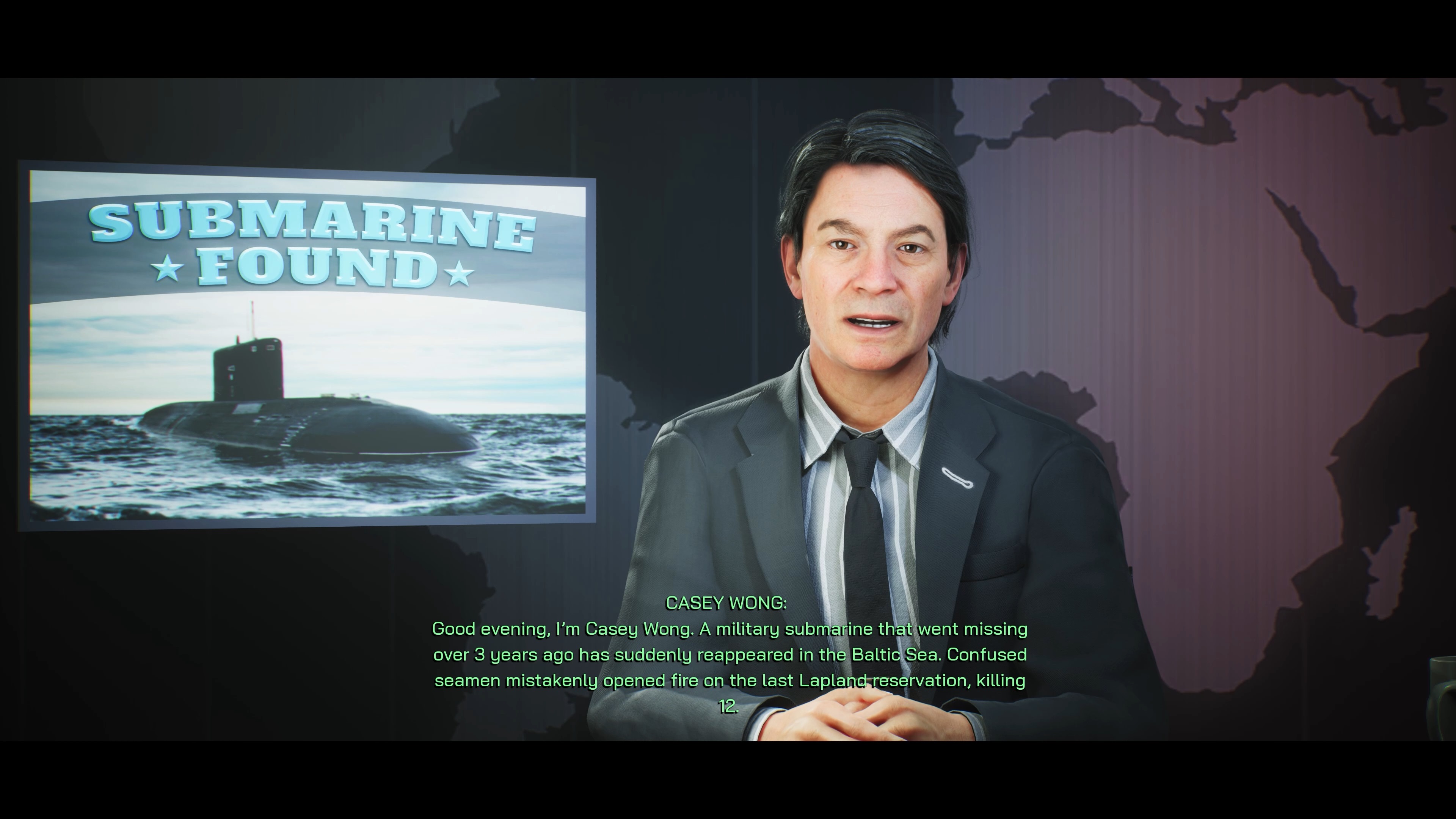
The satire and comedy in Rogue City don’t quite reach the heights of the original movie, but the writing here is not half bad either. There are some amazingly bleak and equally hilarious radio ads and news reports as well as NPC dialog, and one particular ad was so good I briefly thought it was in the original film instead of this game. A raffle to win a random medical procedure sounds like something right out of the original RoboCop, but I actually got it mixed up with the Family Heart Clinic commercial from the film.

I do wish Teyon had been able to implement these as proper TV ads and news reports between chapters like in the movies, maybe even with Mediabreak putting a suitably ridiculous spin on the various quests you’ve completed, but the radios serve as a fun collectible regardless. The tone feels just right, even if the satire isn’t as biting as it would be in a Paul Verhoeven film written by Neumeier and Miner. I suppose I can’t really complain about this video game not being as sharp in its writing as one of the greatest movies of all time, can I?
I could go on for longer, but I’m sure you get the point and this article is already entirely too long. In conclusion, RoboCop: Rogue City is the best RoboCop game ever made and a very entertaining first person shooter in general. Needless to say, it comes highly recommended if you have any interest whatsoever in RoboCop. If you don’t have any interest in RoboCop, you’re probably not going to be reading my ramblings about the game either, so I’m not sure why I even wrote that bit.

 3rd Voice Gaming
exceptional! World’s Largest Electric Vehicle Factory Opens in Germany 2025 tremendous